
— Contribution by our Talent Manager, Ruth Ndwiga.
The venture only grows as far as the founder does.
There are days I look at our venture dashboards and smile.
Revenue is growing.
Customer traction is becoming clearer.
Product-market fit is beginning to emerge.
These are the milestones every venture studio hopes to see.
But over the last eighteen months, I've found myself celebrating something else.
The people behind those numbers.
When our founder journey began, fifty entrepreneurs walked into Bootcamp carrying ideas, ambition and a desire to change Africa's food system.
Today, after months of experimentation, countless customer conversations and difficult decision gates, only a handful remain on the path towards incorporation.
From the outside, that sounds like a story about venture selection.
It isn't.
It is a story about human transformation.
The founders standing before us today are not the same people we met on the first day.
I've watched them question themselves after failed customer interviews.
I've watched them wrestle with uncertainty when assumptions collapsed.
I've watched them almost walk away when the weight of building became heavier than expected.
And then I've watched them return.
A little wiser.
A little humbler.
A little more resilient.
Quietly becoming.
Perhaps that is the work we underestimate most in entrepreneurship.
We spend enormous amounts of time measuring businesses.
☑️Revenue.
☑️Margins.
☑️Customer acquisition.
☑️Cash runway.
☑️Market size.
☑️Growth.
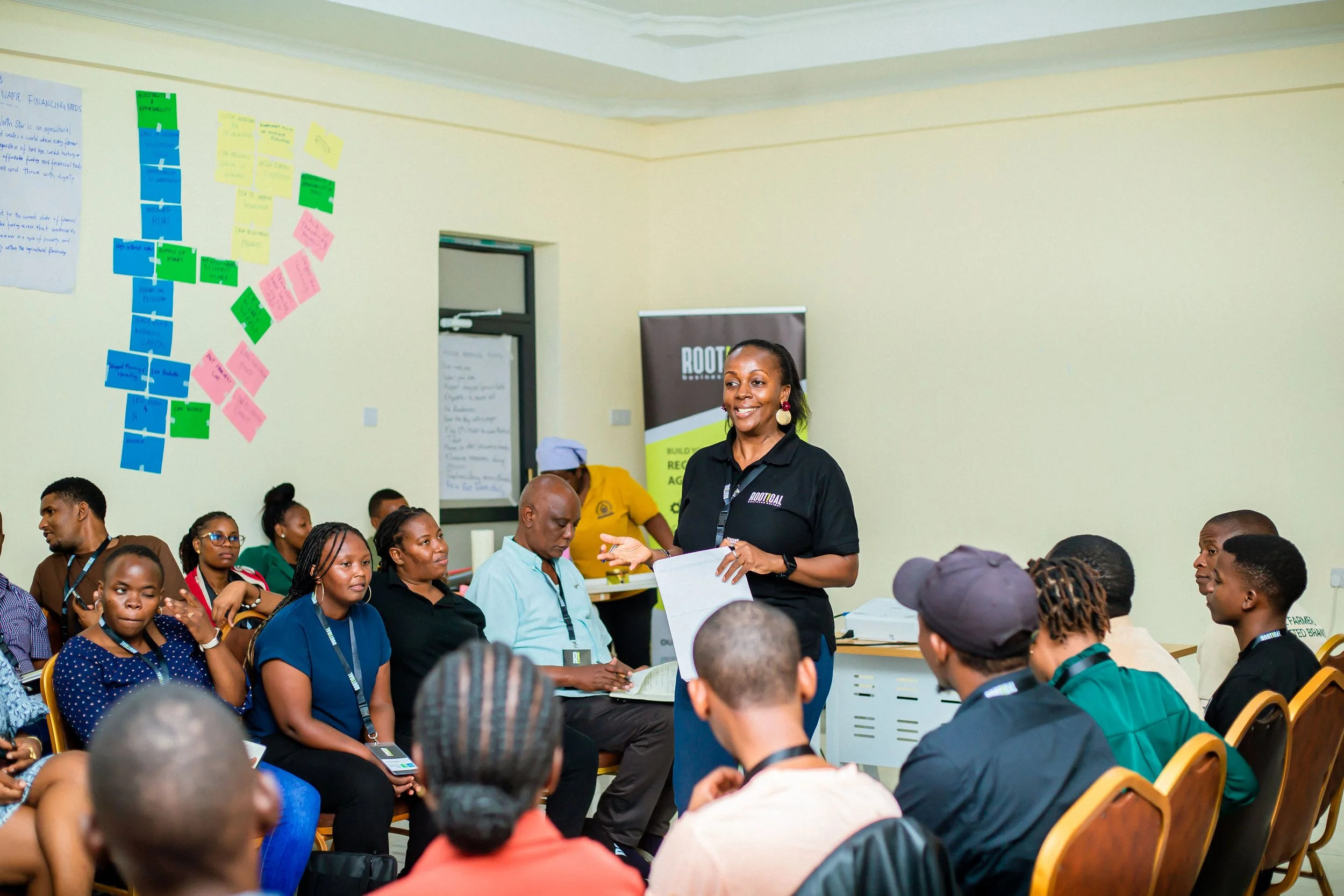
Ruth (standing) alongside the founders during one of the sessions at the Rootical Tanzania Bootcamp.
All important.
Yet the earliest-stage venture is often little more than an extension of its founder.
The founder makes every difficult decision.
Carries every disappointment.
Navigates every uncertainty.
Shapes the culture before there is a team.
Builds trust before there is a brand.
If the founder cannot grow, eventually the venture cannot either.
That is why, inside Rootical, our conversations extend beyond commercial milestones.
We ask questions that rarely appear on investor dashboards.
Is the founder showing up consistently?
Are they becoming more accountable?
Can they learn faster than the market changes?
How do they respond when they fail?
Can they receive difficult feedback without becoming defensive?
Do they have the emotional capacity to lead others?
Are they stewarding the opportunity entrusted to them?
These are not soft questions.
They are strategic ones.
Because markets change.
Products evolve.
Business models pivot.
But a founder's capacity to learn, adapt and lead determines whether any of those changes become opportunities or obstacles.
Perhaps this is where African venture building needs to evolve.
For years we have become better at building startups.
We have improved access to capital.
Incubators.
Accelerators.
Technical assistance.
Founder communities.
All of these matter.
But I wonder whether our next frontier is something deeper.
Not simply founder support.
Founder stewardship.
Stewardship asks a different question.
Not just:
Can this founder build a successful company?
But:
Can this founder become the kind of leader who can carry the responsibility of transforming a food system?
That is a much longer journey.
It requires humility before certainty.
Learning before scale.
Character before charisma.
Resilience before recognition.
Because the greatest constraint to most early-stage ventures is rarely the idea.
It is the human capacity required to keep building long after the excitement has faded.
The food system Africa needs will not be transformed by perfect founders.
It will be transformed by founders who are willing to keep becoming.
And perhaps that is the real investment every venture studio should be making.
Not only in ventures.
But humans are courageous enough to build them.