
Regen Forest Chicken: How Anena Filda Is Redefining Indigenous Poultry Farming in Uganda🍃
When we arrived at Anena Filda’s farm in Gulu, one of the first things that stood out was the relationship between her chickens and the land. Indigenous birds moved freely beneath trees, searching through fallen leaves, vegetation, and the soil for food, while the surrounding landscape provided shade, protection, and a diverse environment for them to thrive.
🎯To many, it may have looked like an ordinary rural farm. But a closer look revealed something more significant: a farming system shaped by years of observation, traditional knowledge, and a deep commitment to protecting nature.
For Filda, this farm is much more than a source of food. It is the foundation of her family’s future.🌿
A widow managing four acres of land, Filda is raising nine children, most of whom are currently in secondary school. Since losing her husband, she has carried the responsibility of providing for her family while ensuring that her children continue their education.
🌿Among the different activities on her farm, indigenous chickens have become one of her most reliable sources of income and resilience.
Through poultry farming, Filda has already supported one of her children, Akite, to reach Senior One. Like for Filda,livestock often serves as a form of financial security for many rural households in Uganda, helping families meet important needs such as school fees, healthcare expenses, and emergencies.
➡️According to the Uganda Bureau of Statistics (UBOS) National Livestock Census and reports from the Ministry of Agriculture, Animal Industry and Fisheries (MAAIF), indigenous chickens make up the majority of Uganda’s poultry population and remain an important livelihood asset for smallholder farmers, particularly women and rural households. Their adaptability, low input requirements, and ability to provide income make them a critical part of Uganda’s rural economy.🍃
➡️However, despite their importance, many indigenous poultry farmers continue to face barriers that prevent them from growing their enterprises, including disease outbreaks, limited access to markets, inadequate housing, and limited technical support.
Filda’s journey reflects both the challenges and the possibilities within Uganda’s indigenous poultry sector.
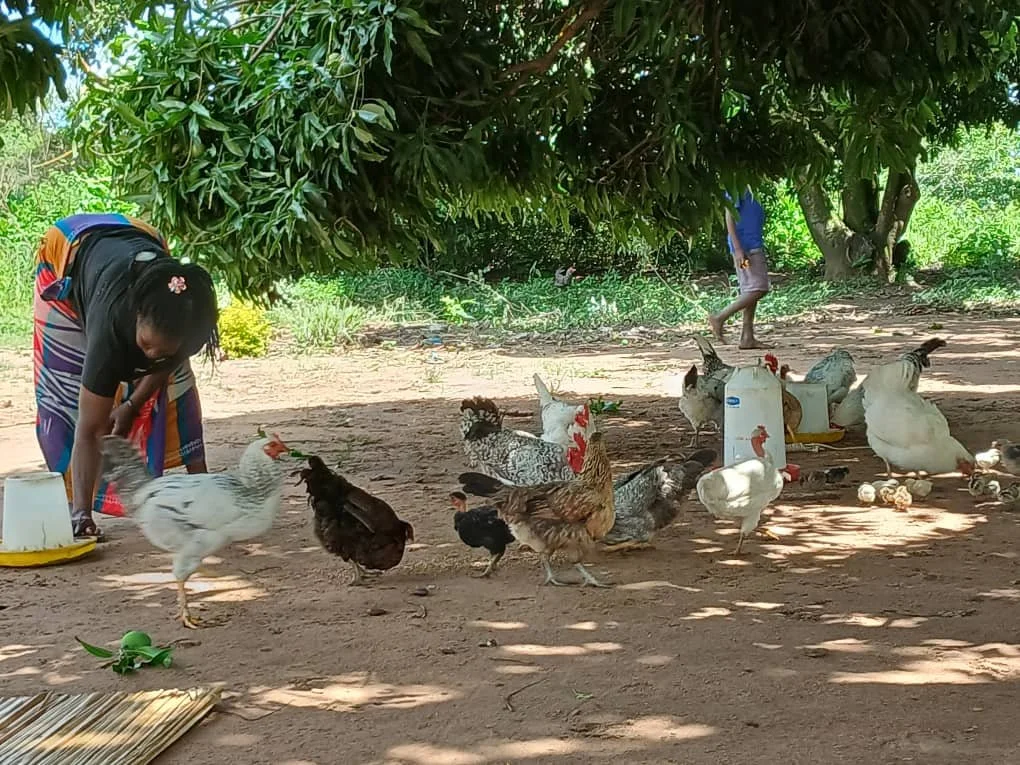
Anena Filda giving feeds to the poultry as they free range
📌A Farm Built Around Regeneration
🍃Before regenerative agriculture became a widely discussed concept, farmers like Filda were already practising many of its principles through experience and a close relationship with their environment.
On her farm, chickens are not separated from the ecosystem around them. They move among trees, forage naturally, and interact with a landscape filled with plants, insects, and organic matter. The farm functions as a connected system where each element supports another. Trees provide shade and help protect the soil. Fallen leaves contribute nutrients back into the soil. Vegetation creates a healthier environment for both livestock and biodiversity.
⚡Filda has also maintained a strong commitment to natural farming practices. She has never relied on synthetic chemicals in managing her chickens and instead uses traditional approaches, including aloe vera-based remedies, to support the health of her flock.🍃
She believes these practices have contributed to the resilience of her chickens. During periods when disease outbreaks affected neighbouring farms, many of her birds survived, reinforcing her belief that the health of the wider ecosystem influences the strength of the animals within it.
While more research is needed to fully understand the relationship between traditional remedies, biodiversity, and poultry health, Filda’s experience reflects an important principle recognised in regenerative agriculture: healthier ecosystems can create more resilient farming systems.🌿
⚡Her farm also demonstrates the potential of natural feed systems. She recalls when amaranth grew abundantly across her land and served as a valuable food source for her chickens. Today, she is exploring how such plants can be intentionally restored and managed as part of a regenerative poultry system.
⚙️The Reality of Growing Indigenous Poultry
🛑Despite her commitment and experience, Filda’s journey has not been without challenges.
At one point, her flock had grown to more than 100 chickens. Today, she manages approximately 45 birds, including nine recently introduced through Regen Forest Chicken. The decline was not caused by a lack of effort. Like many smallholder poultry farmers, Filda faces challenges that can quickly affect household livelihoods.
❗Disease remains a major concern, including conditions such as coccidiosis and respiratory infections. Young chicks are vulnerable to predators such as wild cats, while theft has also resulted in losses when chickens are taken from outdoor nesting areas.
Without secure housing, reliable veterinary support, and consistent markets, many farmers struggle to move beyond small-scale production.
Filda is now working towards rebuilding her flock progressively, first growing from approximately 45 birds to 100 within six months, then expanding towards 300, 500, and potentially 1,000 birds over time. Already, there are signs of progress. Three hens are currently brooding chicks, including one caring for 14 chicks.⛔
For Filda, this growth is not simply about having more chickens. It represents the possibility of creating a stronger, more dependable livelihood while continuing to care for the land that sustains her family.
🌾From Filda’s Farm to a Bigger Vision: The Story Behind Regen Forest Chicken
🚀Filda's journey is not an isolated success story. It reflects a bigger vision taking shape across Northern Uganda, one that sees indigenous chickens not simply as livestock, but as a way to restore landscapes, strengthen rural livelihoods, and build regenerative food systems. That vision is called Regen Forest Chicken.
For many smallholder farmers, the challenge has never been a lack of knowledge. They understand their land, care for indigenous chicken breeds that thrive in local conditions, and have long relied on practices passed down through generations. What has often been missing is the support to turn that knowledge into resilient and profitable farming businesses.
🌟This opportunity inspired Juliet Akumu, who co-founded Regen Forest Chicken together with Rootical. Through years of working alongside farming communities and supporting agroecological approaches, Juliet noticed a pattern. Farmers were already practising many of the principles of regeneration.
They protected trees because they understood their value, kept indigenous chicken breeds because they were hardy and well adapted, and relied on local knowledge that had sustained their families for generations.🔍
The challenge was not teaching farmers something entirely new. It was creating a model that connected what they already knew with stronger markets, healthier landscapes, and more sustainable livelihoods.
🌟This understanding became the foundation of Regen Forest Chicken.
💡Building a Regenerative Poultry Model for Uganda
✨Regen Forest Chicken was created around a simple vision: indigenous poultry farming can become a pathway for both economic opportunity and ecological restoration.
Rather than replacing traditional poultry systems with intensive industrial approaches, the model builds on what farmers already understand and strengthens those practices through better support, market connections, and regenerative approaches.
The initiative helps farmers raise indigenous chickens in ways that work with nature. Farmers integrate trees, legumes, and other regenerative crops into their farms, creating healthier environments for both the birds and the land while improving soil fertility and farm productivity.Through Regen Forest Chicken, farmers are supported to:
Expand indigenous chicken production sustainably.
🔹Integrate trees, legumes, and regenerative crops into poultry systems.
🔹Improve soil health and biodiversity.
🔹Reduce dependence on external inputs, feed and antibiotics in particular.
🔹Access reliable markets for naturally raised poultry.
⚠️The model recognises an important reality in many communities across Northern Uganda: chickens are not simply food. They are household assets.
🌱Why Farmers Like Filda Matter
🔔Filda represents the kind of farmer at the centre of Regen Forest Chicken’s vision.
She was not introduced to regeneration as a new idea. She was already protecting trees, valuing indigenous breeds, maintaining biodiversity, and using natural approaches in her farming.
What she needed was support to grow.
Through Regen Forest Chicken, Juliet and the team are testing how farmer knowledge, regenerative practices, and market access can come together to create a scalable poultry model.
👏The partnership with Filda goes beyond increasing the number of chickens on her farm. It includes improving poultry housing, strengthening farm design as a “food forest for chicken”, supporting flock growth, and creating a reliable market pathway by connecting farmers with buyers who value naturally raised poultry.
📊Restoring Landscapes Through Food Systems
📌Uganda’s agricultural future depends on the health of its landscapes. The country continues to face challenges linked to forest loss, declining soil health, and climate pressures.
Research from the Food and Agriculture Organization (FAO) highlights the importance of agroforestry and integrated farming systems in improving biodiversity, restoring degraded land, increasing carbon storage, and strengthening resilience to climate change.
👏Regenerative poultry systems contribute to this vision by creating farms where animals, plants, and soils support one another.
On Filda’s farm, this relationship is already visible.
🔸The trees protect the land.
🔸The land supports the chickens.
🔸The chickens contribute nutrients back into the system.
🔸Together, these elements create a more resilient farming environment.