
Isaac Muhofa | Studio Venture Builder, Rootical
What does it really take to build a business that can change a food system?
🍃It is tempting to think the answer is a good idea, enough funding and a market ready to buy. But spend time with a venture builder and a different picture emerges. Before there is a product, there are conversations, traction,experiments. Before there is a business model, there are assumptions to test, customers to understand and problems to sit with for much longer than is comfortable.
Sometimes, it means going back to the drawing board after months of work. Sometimes, it means abandoning the product a founder thought would define their business. Sometimes, it means discovering that the real thing being built is not the original idea at all, but the founder behind it.
This is the other side of venture building.
And at Rootical, it is much of the work that Isaac Muhofa does.
Isaac joined Rootical in 2023 as part of the pioneering team of the Rootical Studio, bringing more than nine years of experience building impactful and scalable ventures across Uganda and Africa. Today, he works closely with our founders in the studio building over 5 businesses at the intersection of agriculture, food, livelihoods and regeneration.
His work starts long before a venture looks like a venture.
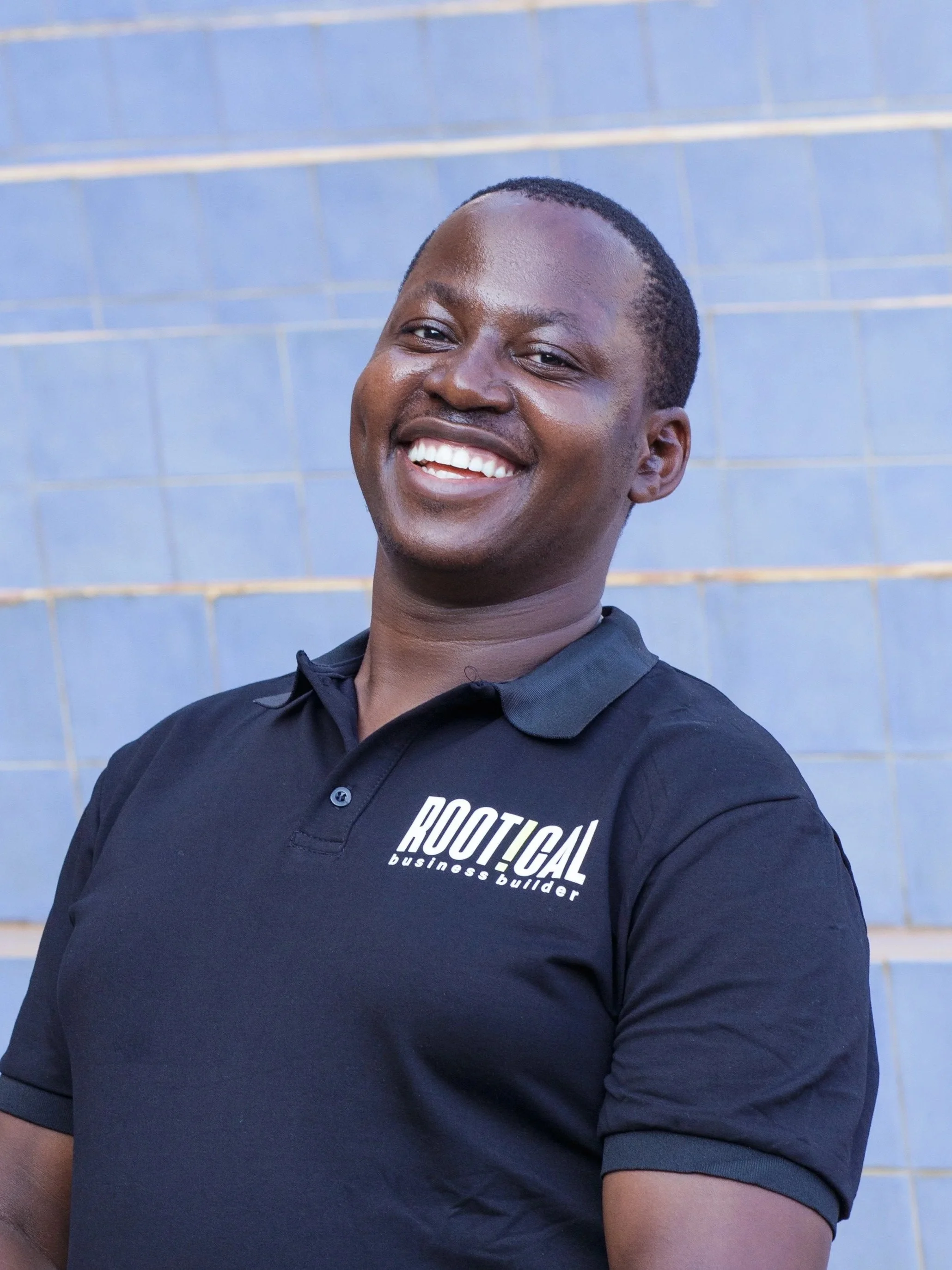
Isaac Muhofa
Studio Venture Builder, Rootical
📌Before the business comes the problem
🔄At the bootcamp stage, where more than 50 changemakers begin the venture-building journey, Isaac helps founders interrogate the problems they want to solve before becoming attached to the solutions they have imagined. As he likes to say “Fall in love with the problem not the solution”
✅Who is experiencing the problem?
✅What does it actually look like in their daily lives?
✅What have they already tried?
✅What would make them change?
And, perhaps most importantly, is this a problem people will actually pay to have solved? Must be intentional about solving the pain point of the target customer.
From there, founders move through sprints where ideas are tested, developed and iterated. Solutions are questioned, prototypes are refined and assumptions are confronted before ventures enter the Studio.
The process is deliberately uncomfortable because a good idea is not necessarily a good business.
By the time founders reach the Studio, many arrive believing their idea could become the next venture shaping the food system. What they discover is that building takes time, Ideas are tested with farmers, customers, markets, costs and reality, with the community at the centre.
As Isaac puts it, “Trusting the process.”
Sometimes that process leads to a pivot, an entirely different business, sometimes it reveals that the most valuable thing a founder can build is not the venture they started with, but the ability to understand a problem deeply enough to know what is worth solving.
That is why the work begins with the problem, not the product.
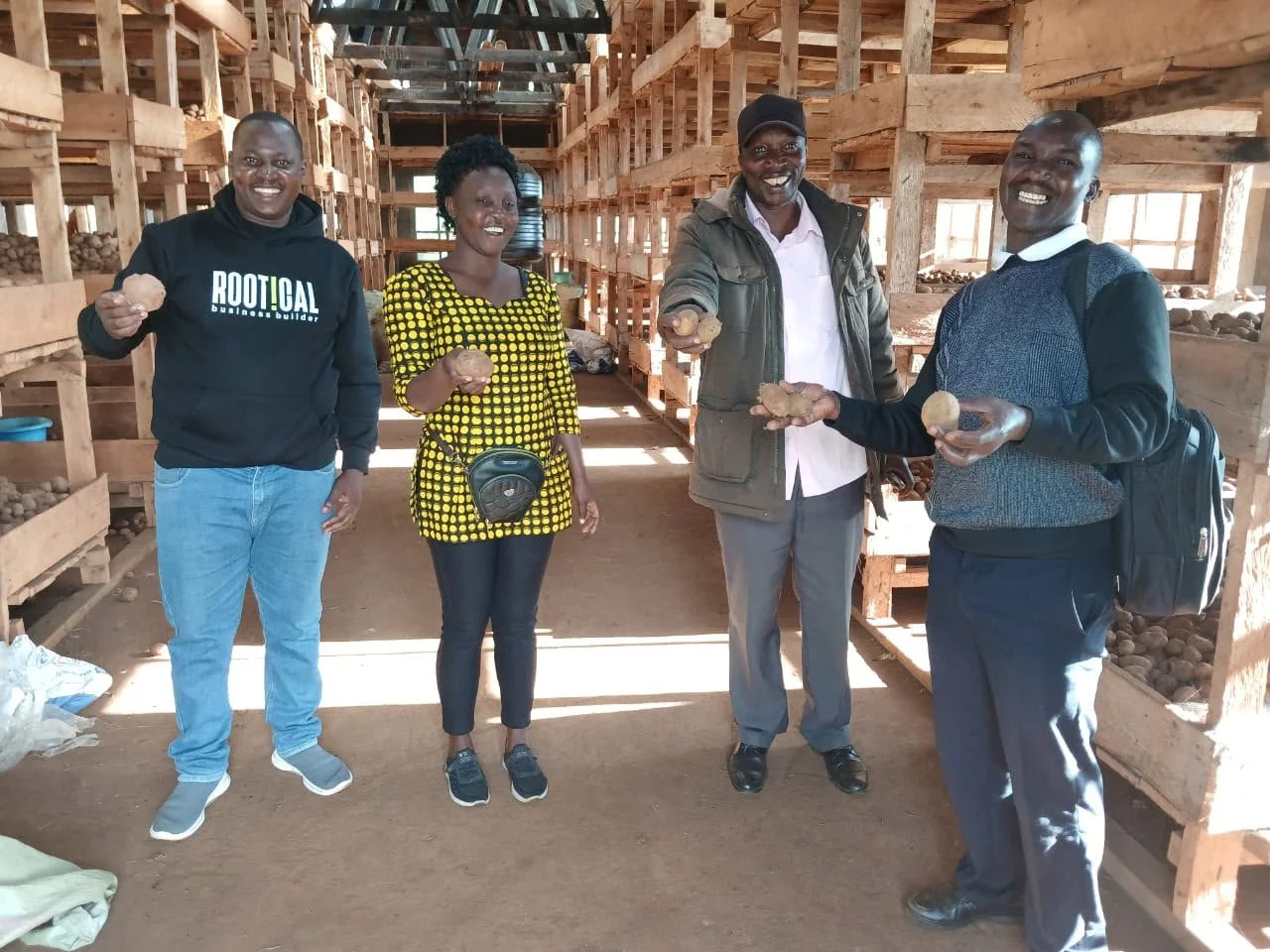
Isaac Muhofa extreme right, Dianah Chebet second left with some of the farmers
🎯The real venture is often the founder
One of Isaac’s strongest observations from working with founders is simple: people matter as much as ideas.
It is easy to become fascinated by the size of a problem or the sophistication of a proposed solution. But venture building eventually brings the conversation back to the person behind the business.
✅Who keeps showing up?
✅Who is willing to listen?
✅Who records what is happening instead of relying on assumptions?
✅Who can admit when something is not working?
✅Who is willing to change direction?
For Isaac, the strongest founders are not necessarily the ones with the most polished ideas but rather are the ones who remain curious, humble enough to learn, willing to get their hands dirty and disciplined enough to pay attention to the small things that happen every week.
Uganda’s agriculture, forestry and fishing sector accounted for 26.1% of the country’s GDP in FY2024/25, according to revised Uganda Bureau of Statistics figures, up from 24.6% the previous financial year. The sector also grew by 6.8% during the year.
The numbers point to the scale of agriculture in Uganda’s economy, but they do not capture the complexity of building businesses within it.
A founder working in agriculture has to understand farmers, seasons, cash flows, production risks, relationships, markets and the realities that influence decisions on the ground. If the ambition is to support a transition towards regenerative food systems, there is another layer to understand: what makes farmers willing to change practices, what makes those practices economically viable and what evidence gives them confidence to do so.
This is where Isaac’s work becomes less about building a business plan and more about building the person capable of navigating reality.
A founder who shows up consistently can learn, records what is happening can see patterns, willing to admit that something is not working can change direction, and sometimes, that ability to change direction is what keeps a promising idea alive.
🌍When failure becomes useful
One of the clearest examples is the evolution of Juliet Akumu’s venture, Regen Forest Chicken.
The original model explored opportunities around farmers growing soy, including producing cooking oil and potentially developing feeds for farmers. But as the venture-building process unfolded, the team began to see a stronger connection with poultry.
The business pivoted.
Juliet moved towards raising indigenous, free-range chickens under natural tree canopies, with the aim of restoring degraded ecosystems, enhancing biodiversity and creating livelihoods for local farmers.
But even that model continued to evolve.
Rather than simply supplying chickens to farmers and carrying much of the responsibility when things went wrong, the model moved towards a facility where farmers could receive resources and decide how best to invest them, whether in chickens, housing, hatching facilities or seedlings.
Something important changed in that process.
Farmers began to see the chickens as their chickens and the enterprise as their business. Responsibility moved closer to the people who understood their farms best.
By the time Isaac reflected on the evolution, Juliet had sold about 103 chickens over a three-month period, with sales picking up over the following months.
But the sales were not the only important outcome.
Juliet was learning to understand and adjust her own model rather than simply implementing a predetermined plan.
That is one of the less visible outcomes of venture building.
The goal is not to protect founders from failure. It is to help them learn quickly enough from failure to build something better.
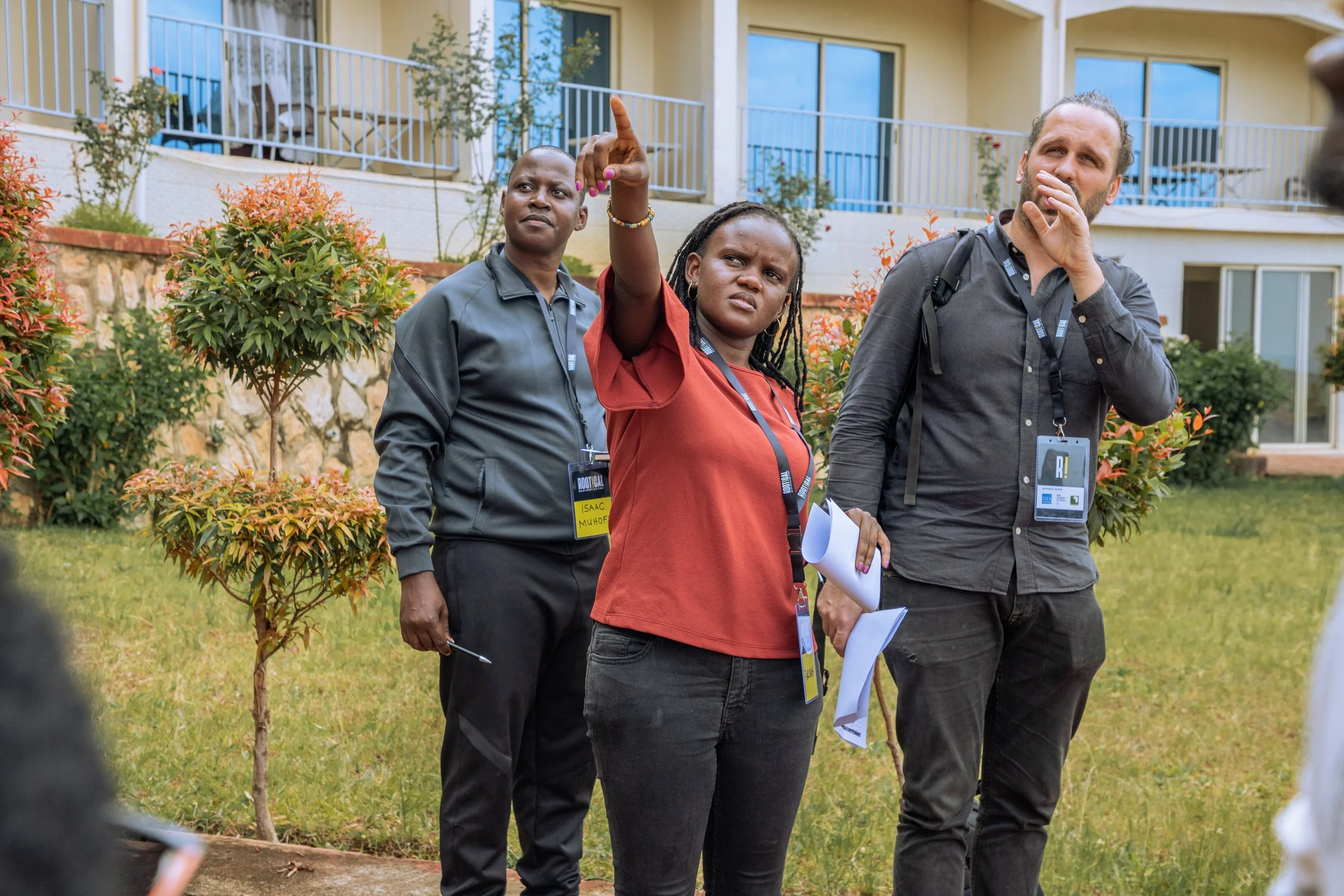
Isaac Muhofa (extreme right), Faridah Nalunkuuma (former Talent Manager, centre), and Hannes Van den Eeckhout during the first Rootical Bootcamp.
Why this work matters beyond one venture🌿
🌟The context in which these businesses are being built makes the work even more significant.
Across Africa, food systems are under enormous pressure. FAO estimates that 306 million people in Africa were undernourished in 2024, while 67% of the continent’s population could not afford a healthy diet. The average cost of a healthy diet was estimated at US$4.41 per person per day in purchasing-power-parity terms.
At the same time, the way food is produced, processed, transported, consumed and disposed of has consequences far beyond food security. Agrifood systems account for about one-third of human-caused greenhouse-gas emissions globally, according to FAO.
This creates a difficult but important question.
How do we build businesses that can make regenerative practices practical, accessible and commercially viable while contributing to food systems that can better serve people and the planet?
For Isaac, this is where agroecology entrepreneurship becomes important: Building businesses that help agroecological practices reach more farmers, connect regenerative producers to reliable markets, and ensure that promising solutions are financially viable enough to grow and create lasting impact.
The ecosystem needs businesses that bring these different pieces together rather than addressing them in isolation.
The missing links
✨Isaac sees several opportunities that remain underdeveloped.
One is finance.
Farmers earn seasonally but spend continuously. Financial products designed around conventional monthly cash flows may therefore fail to reflect the realities of farming. There is room for financing models that understand agricultural economics while recognising the realities of regenerative production.
Another is aggregation and processing.
Many agroecological producers remain small-scale and disconnected from larger markets. Without systems that aggregate, process and distribute their products, increased production does not necessarily translate into increased commercial opportunity.
Then there is data.
For Isaac, data could become one of the most powerful tools for moving regenerative agriculture from promising practice into stronger economic systems.
☑️If regenerative seed systems are to influence policy, there needs to be evidence.
☑️If agroecological practices are to attract finance, there needs to be evidence.
☑️If farmers are to confidently change practices, there needs to be evidence that demonstrates what works in real communities, under real conditions.
☑️FAO similarly emphasises the importance of timely and reliable agricultural data for policy, investment and decision-making.
☑️This makes venture building bigger than individual companies.
☑️Each venture can become a source of learning.
☑️Each farmer interaction can generate evidence.
☑️Each experiment can reveal something about what works.
Over time, these individual pieces can begin to form a body of knowledge capable of informing markets, capital and eventually policy.🌿
From ventures to a movement☀️
🎯That is why Isaac is interested in more than whether one venture succeeds. He is interested in whether enough entrepreneurs can build businesses that demonstrate, through their everyday operations, what another kind of food system could look like and what it would take to make it work.
A seed company that helps farmers access reliable regenerative seeds, a financing business that responds to seasonal realities, a food business that successfully aggregates agroecological producers, and a community-owned water business that demonstrates an alternative model are all creating practical evidence that regenerative alternatives can work.
While each individual business matters in its own right, their collective contribution is equally important because, together, they begin to show what is possible when different parts of the food system work towards a shared vision. One venture can demonstrate a possibility, but a network of ventures can begin to demonstrate that an entire system can work differently.
And that is where Isaac sees the bigger opportunity: building a critical mass of changemakers whose businesses do more than generate revenue; they create practical evidence, strengthen local economies and demonstrate that regenerative alternatives can thrive in real markets and communities.🍃
The work people do not always see🍃
There is a temptation to measure venture building through the visible outcomes: revenue, customers, jobs, investment and growth.
Those metrics matter, but they do not capture everything.
There is also the founder who learns to listen before building, the entrepreneur who learns to recognise a failed assumption, the farmer who begins to see an enterprise as their own, the team that learns to use evidence rather than instinct alone, and the business that discovers a better model because someone asked a difficult question at the right time.
These are quieter forms of progress, but they compound.
After more than nine years of working across Uganda and Africa, and since joining Rootical in 2023, Isaac has become part of that quieter architecture. He works directly with founders in the Studio, helping them navigate the messy space between an idea and a viable venture. He brings agroecology into conversations about business models, customer needs, finance, markets and scale.
More importantly, he helps founders understand that building a regenerative business does not have to mean choosing between impact and commercial viability.
The ambition is to make them reinforce each other.
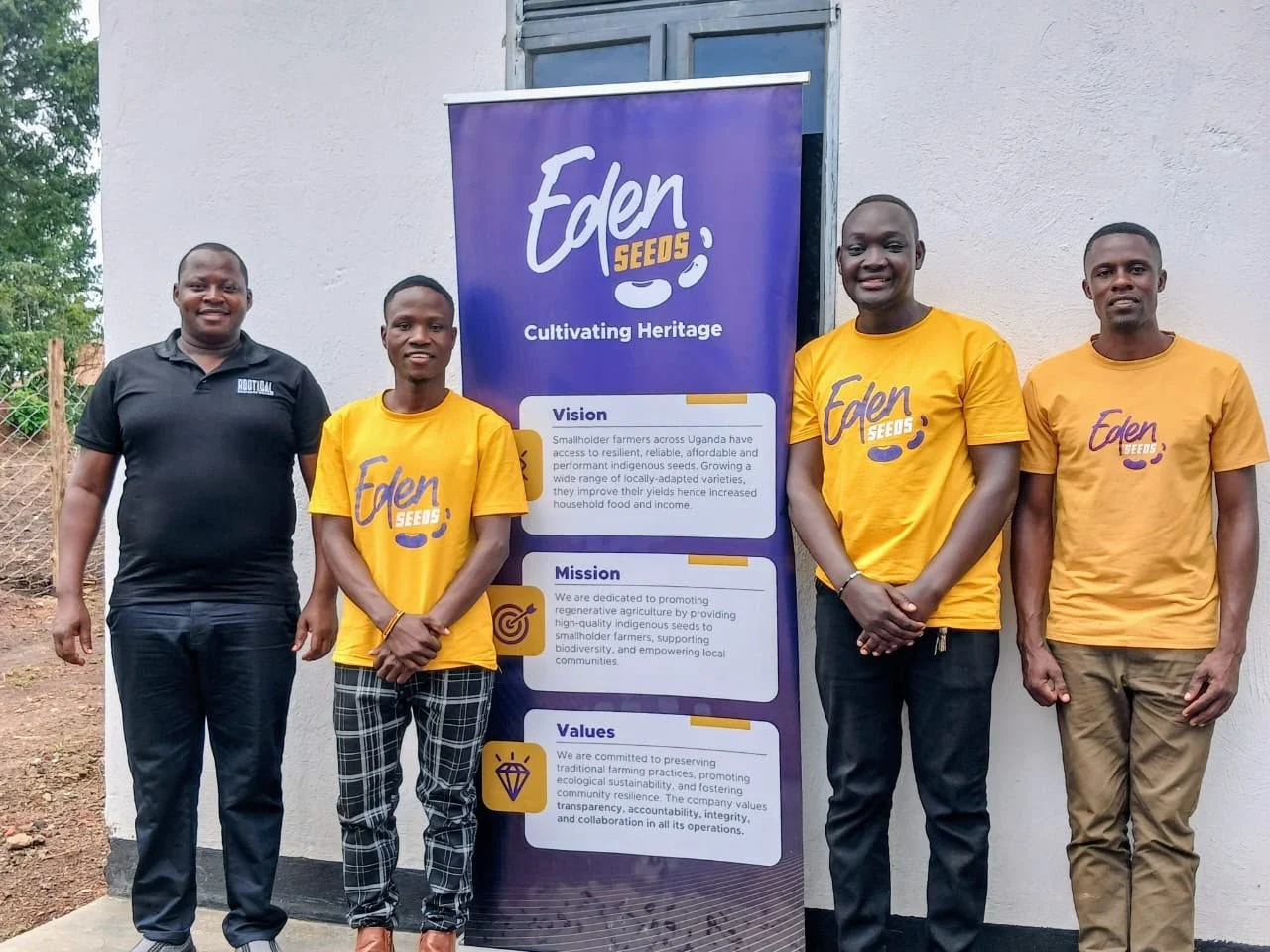
Isaac Muhofa (extreme right) pictured with the Eden Seeds team.
Isaac is not simply helping entrepreneurs build companies. He is helping develop the people capable of building the companies that Uganda’s food system needs right now — one founder, one experiment and one piece of evidence at a time.
If enough of those pieces come together, the result could be much bigger than a portfolio of ventures.
It could be the beginnings of a different kind of food economy — one that is commercially viable, environmentally regenerative, rooted in local realities and built by a growing generation of African entrepreneurs who understand that the future is not something to wait for.
It is something to build.